

As a digital subscriber, you’ll receive unlimited access to Horn Book web exclusives and extensive archives, as well as access to our highly searchable Guide/Reviews Database.
To access other site content, visit The Horn Book homepage.
To continue you need an active subscription to hbook.com.
Subscribe now to gain immediate access to everything hbook.com has to offer, as well as our highly searchable Guide/Reviews Database, which contains tens of thousands of short, critical reviews of books published in the United States for young people.
Thank you for registering. To have the latest stories delivered to your inbox, select as many free newsletters as you like below.
No thanks. Return to article
64 pp.
| Cicada |
October, 2025 |
TradeISBN 9781800660564$21.99
(2)
4-6
Illustrated by
Cristóbal Schmal.
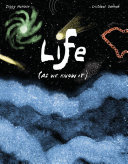
Introducing the evolution of life on Earth in sixty-four pages is like eating a metaphorical elephant: one takes it one bite at a time. Hanaor’s bites start be-fore the Big Bang and conclude with a speculative future. Chronological events appear as captions in the graphic novel–style panels, sometimes covering long periods of time: “Very slowly over billions of years, the tiny cells gradually changed, becoming more efficient at living in their environment. This is called EVOLUTION. They begin to make fuel from the sun, releasing waste gas back into the air. This process is called PHOTOSYNTHESIS. The waste gas is called OXYGEN.” The captioning continues, with panels and some single-page illustrations; full-bleed double-page spreads break this flow to signal pivotal events such as the K-T extinction. Schmal’s eye-catching illustrations, with the look of watercolor, ink, and collage, mirror the narrative. Hanaor clearly states that there is much we do not know, both about these specific events and about early plants and animals, a theme reflected beautifully in the pictures -- many suggest, rather than identify, early life forms, and in one case an illustration shows six upright mammals, creating an evolutionary chain from apes to humans. The work concludes with a certainty: in the future, as in the past, there will be change. A solid chronological overview.
Reviewer: Betty Carter
| Horn Book Magazine Issue:
November, 2025