

As a digital subscriber, you’ll receive unlimited access to Horn Book web exclusives and extensive archives, as well as access to our highly searchable Guide/Reviews Database.
To access other site content, visit The Horn Book homepage.
To continue you need an active subscription to hbook.com.
Subscribe now to gain immediate access to everything hbook.com has to offer, as well as our highly searchable Guide/Reviews Database, which contains tens of thousands of short, critical reviews of books published in the United States for young people.
Thank you for registering. To have the latest stories delivered to your inbox, select as many free newsletters as you like below.
No thanks. Return to article
(2)
K-3
Illustrated by
Anna Bron.
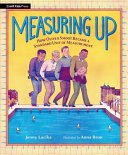
This unusual nonfiction picture book combines math, hijinks, and etymology -- a subject amalgamation readers don’t encounter every day. In the mid-twentieth century, a group of MIT students wanted to measure the length of one of the bridges spanning the Charles River between Boston and Cambridge -- without using a standard unit of measurement or a measuring tape. In-stead, one of the students, 5’ 7” Oliver Smoot, repeatedly lay down with his feet pointing toward Boston and his head toward Cambridge until he traversed the bridge, a surprisingly exhausting endeavor that required his friends’ assistance. The length of each lie-down became a “smoot,” with the bridge’s distance totaling 364.4 smoots +/- 1 3ar (with 3ar allowing for minuscule human error). Every year afterward, MIT students repainted the smoot markings, and when a new bridge was constructed in the late 1980s, the sidewalk was scored with these same measurements, preserving the oddball tradition. The colorful digital illustrations signal a historical setting and amusingly incorporate mathematical symbols. Near the end of the engaging main text, a chart shows the smoot’s equivalents in other measurement systems, such as feet and millimeters, with a playful depiction of Oliver Smoot himself stretched out across the bottom row. Additional material discusses the MIT tradition of practical jokes, or “hacks,” with resources for further exploration. Also appended with more information about smoots, a bibliography, and a list of other measurements named for their inventors.
Reviewer: Betty Carter
| Horn Book Magazine Issue:
November, 2025